
Rain has always inspired poets, writers, and dreamers. It carries emotion, movement, and meaning—making it a perfect subject for figurative language.
One of the most powerful tools in writing is the simile, a comparison using “like” or “as” to create clear and imaginative pictures in the reader’s mind. Similes help transform ordinary descriptions into something memorable and expressive.
They are essential in storytelling, poetry, and even everyday communication because they make ideas easier to understand and more engaging.
When we talk about beautiful rain similes, we’re exploring comparisons that reflect strength, growth, resilience, wisdom, and deep human emotion.
Rain can symbolize renewal, sadness, peace, or even hope, depending on how it’s described. By using similes, writers can capture these meanings in a vivid and relatable way.
Whether you’re writing a poem, an essay, or a story, rain similes can add emotional depth and sensory detail.
This article will guide you through powerful examples and show you how to use them effectively.
What Is a Simile?
A simile is a figure of speech that compares two different things using the words “like” or “as” to highlight a shared quality.
Example: The rain fell like silver threads from the sky.
This comparison helps the reader imagine rain as delicate and shimmering, adding beauty to a simple description.
1. Rain like silver threads from the sky
Meaning: Gentle, thin, and shimmering rain
Usage Insight: Perfect for poetic or calm descriptions
Examples:
- The rain fell like silver threads from the sky, soft and graceful.
- She watched the rain like silver threads dancing in the light.
- The evening turned magical as rain draped the air like silver threads.
- Rain like silver threads blurred the distant hills.
- It whispered down like silver threads over the quiet town.
2. Rain like tears from heaven
Meaning: Sad, emotional rainfall
Usage Insight: Ideal for emotional or reflective writing
Examples:
- The rain poured like tears from heaven during the funeral.
- It felt as though the sky was crying, rain like tears from heaven.
- Rain like tears from heaven matched her sorrow.
- The storm came down like tears from heaven, heavy and relentless.
- His mood mirrored the rain like tears from heaven.
3. Rain like a curtain falling
Meaning: Thick, continuous rain
Usage Insight: Useful for describing heavy rainfall scenes
Examples:
- Rain fell like a curtain, hiding everything beyond.
- The city disappeared behind rain like a curtain.
- It poured like a curtain closing the world off.
- Rain like a curtain blocked the view of the road.
- The forest vanished in rain like a curtain.
4. Rain like a gentle lullaby
Meaning: Soft, calming rain
Usage Insight: Best for peaceful or relaxing scenes
Examples:
- The rain sounded like a gentle lullaby on the roof.
- She slept as rain sang like a lullaby.
- Rain like a lullaby soothed his restless mind.
- The night was quiet except for rain like a gentle lullaby.
- It comforted her like a lullaby drifting through the air.
5. Rain like dancing diamonds
Meaning: Sparkling, lively rain
Usage Insight: Great for bright, joyful imagery
Examples:
- The rain sparkled like dancing diamonds in the sunlight.
- Drops bounced like dancing diamonds on the ground.
- Rain like dancing diamonds lit up the morning.
- It shimmered like dancing diamonds across the lake.
- The storm ended with rain like dancing diamonds.
6. Rain like whispers in the dark

Meaning: Quiet and mysterious rain
Usage Insight: Ideal for suspense or calm night scenes
Examples:
- Rain fell like whispers in the dark night.
- The forest echoed with rain like whispers.
- It crept in like whispers in the dark.
- Rain like whispers filled the silence.
- The night felt alive with rain like whispers.
7. Rain like a rushing river
Meaning: Fast, heavy rain
Usage Insight: Use for intense weather descriptions
Examples:
- Rain poured like a rushing river from the clouds.
- The streets flooded with rain like a river.
- It came down like a rushing river in seconds.
- Rain like a river swept across the land.
- The storm roared with rain like a rushing river.
8. Rain like pearls scattered on glass
Meaning: Light, delicate raindrops
Usage Insight: Works well in descriptive imagery
Examples:
- Rain tapped like pearls on the window.
- Drops lay like pearls scattered on glass.
- It sounded like pearls falling softly.
- Rain like pearls decorated the surface.
- The window shimmered with rain like pearls.
9. Rain like arrows from the sky
Meaning: Sharp, forceful rain Usage Insight: Perfect for stormy scenes
Examples:
- Rain struck like arrows from the sky.
- The storm attacked like arrows of rain.
- It hit the ground like arrows.
- Rain like arrows made it hard to walk.
- The wind drove rain like arrows.
10. Rain like a painter’s brush
Meaning: Creative, artistic rain
Usage Insight: Use for artistic descriptions
Examples:
- Rain moved like a painter’s brush across the fields.
- The sky painted the earth with rain like a brush.
- It colored the world like a painter’s brush.
- Rain like a brush added beauty everywhere.
- The scene transformed like art under rain.
11. Rain like soft footsteps
Meaning: Quiet, barely noticeable rain
Usage Insight: Ideal for peaceful, subtle, or reflective scenes
Examples:
- The rain arrived like soft footsteps on the roof.
- It crept in like soft footsteps across the garden.
- Rain like soft footsteps barely disturbed the silence.
- The night deepened as rain moved like soft footsteps.
- It felt calming, like soft footsteps passing by.
12. Rain like shattered glass
Meaning: Sharp, loud, and chaotic rainfall
Usage Insight: Best for intense storm imagery
Examples:
- Rain hit the windows like shattered glass.
- The storm roared with rain like shattered glass.
- Drops crashed like shattered glass on the ground.
- Rain like shattered glass filled the air with noise.
- It sounded harsh, like shattered glass falling everywhere.
13. Rain like a blessing from above
Meaning: Life-giving, refreshing rain
Usage Insight: Perfect for hopeful or positive themes
Examples:
- After weeks of heat, rain came like a blessing from above.
- Farmers welcomed the rain like a blessing.
- It fell gently, like a blessing from above.
- The dry land drank rain like a blessing.
- Rain like a blessing brought life back to the fields.
14. Rain like a ticking clock
Meaning: Steady, rhythmic rain
Usage Insight: Great for emphasizing time or quiet tension
Examples:
- Rain tapped like a ticking clock on the window.
- The silence was broken by rain like a ticking clock.
- It echoed like a ticking clock through the night.
- Rain like a ticking clock marked the passing hours.
- The steady rhythm of rain felt like a ticking clock.
15. Rain like falling feathers
Meaning: Light, soft, and slow rain
Usage Insight: Ideal for dreamy or gentle imagery
Examples:
- Rain drifted down like falling feathers.
- The sky released drops like soft feathers.
- It floated gently, like feathers in the air.
- Rain like falling feathers touched the earth softly.
- The scene felt magical with rain like feathers.
16. Rain like a roaring crowd
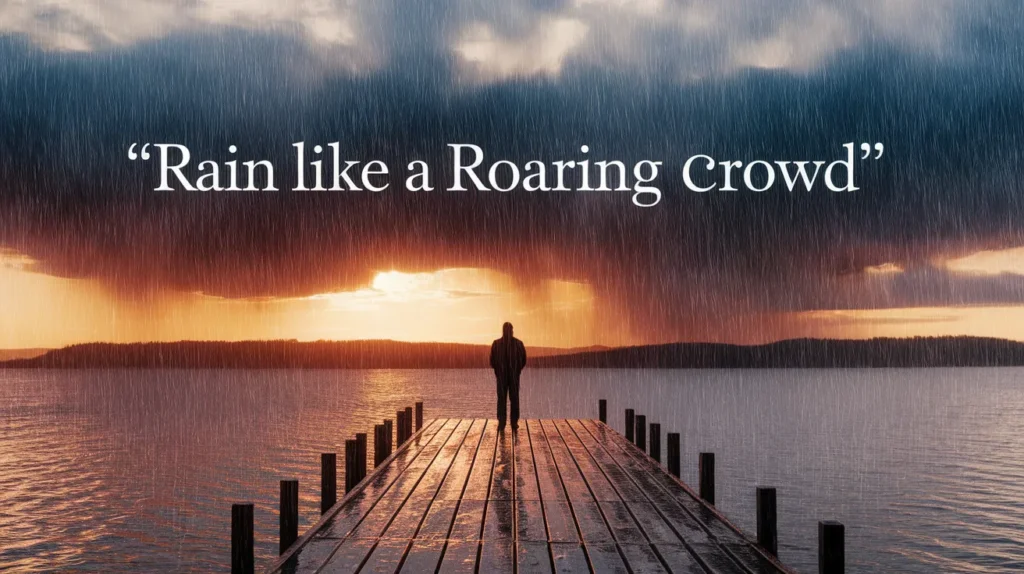
Meaning: Loud and overwhelming rain
Usage Insight: Perfect for dramatic storm scenes
Examples:
- The storm sounded like a roaring crowd overhead.
- Rain crashed like a roaring crowd in a stadium.
- It grew louder, like a crowd cheering wildly.
- Rain like a roaring crowd filled the valley.
- The noise surrounded them like a roaring crowd.
17. Rain like a silver veil
Meaning: Thin, elegant rain covering everything
Usage Insight: Great for romantic or scenic descriptions
Examples:
- The valley was covered in rain like a silver veil.
- It draped the city like a delicate veil.
- Rain like a silver veil softened the view.
- The mountains faded behind a silver veil of rain.
- It created a dreamy look like a silver veil.
18. Rain like a heartbeat
Meaning: Rhythmic, steady rain
Usage Insight: Useful for emotional or reflective writing
Examples:
- Rain pulsed like a heartbeat in the quiet room.
- The rhythm felt like a steady heartbeat.
- Rain like a heartbeat calmed his thoughts.
- It echoed gently like a heartbeat in the night.
- The steady fall of rain felt like life itself.
19. Rain like scattered seeds
Meaning: Light rain spreading across an area
Usage Insight: Ideal for nature and growth symbolism
Examples:
- Rain fell like scattered seeds across the field.
- It spread gently like seeds in the wind.
- Rain like seeds promised new growth.
- The drops scattered like seeds on soil.
- It nurtured the earth like seeds of life.
20. Rain like a cooling balm
Meaning: Soothing, refreshing rain
Usage Insight: Best for relief after heat or stress
Examples:
- The rain felt like a cooling balm on the skin.
- It washed over the city like a soothing balm.
- Rain like a balm eased the summer heat.
- It brought comfort like a cooling touch.
- The air refreshed with rain like a balm.
21. Rain like flowing silk
Meaning: Smooth, continuous rain
Usage Insight: Great for elegant descriptions
Examples:
- Rain flowed like silk across the hills.
- It moved smoothly like silk in motion.
- Rain like flowing silk covered the ground.
- The scene softened with rain like silk.
- It felt graceful like silk falling from the sky.
22. Rain like a storm of applause
Meaning: Loud, energetic rain
Usage Insight: Perfect for lively or powerful scenes
Examples:
- Rain hit the roof like a storm of applause.
- The sky clapped with rain like applause.
- It sounded like endless cheering above.
- Rain like applause filled the night.
- The storm ended with a final burst like applause.
23. Rain like tiny drums
Meaning: Rhythmic tapping sound
Usage Insight: Ideal for sound-focused descriptions
Examples:
- Rain tapped like tiny drums on the roof.
- It echoed like drums in the distance.
- Rain like tiny drums created a steady beat.
- The sound felt musical like soft drumming.
- It played gently like tiny drums in the night.
24. Rain like a broken necklace
Meaning: Drops falling unevenly and scattered
Usage Insight: Useful for visual imagery
Examples:
- Rain fell like a broken necklace of pearls.
- Drops scattered like beads on the ground.
- It shimmered like a broken necklace in light.
- Rain like beads rolled across the surface.
- The pattern looked like a necklace undone.
25. Rain like a cleansing wave
Meaning: Purifying and renewing rain
Usage Insight: Great for themes of renewal
Examples:
- Rain washed over the city like a cleansing wave.
- It cleared the air like a fresh wave.
- Rain like a wave renewed the earth.
- The storm felt like a cleansing force.
- It left everything fresh like a wave passing through.
26. Rain like shimmering dust

Meaning: Fine, glowing rain
Usage Insight: Ideal for magical or dreamy imagery
Examples:
- Rain sparkled like shimmering dust in sunlight.
- It floated like dust in the golden air.
- Rain like shimmering dust created a magical scene.
- The drops glowed like tiny particles.
- It looked like dust made of light falling down.
27. Rain like a sigh of relief
Meaning: Gentle and comforting rain
Usage Insight: Perfect for emotional release
Examples:
- The rain came like a sigh of relief after the heat.
- It softened the air like a quiet sigh.
- Rain like a sigh eased the tension.
- It felt calming like a deep breath.
- The earth relaxed with rain like a sigh.
28. Rain like a hidden melody
Meaning: Soft, musical rain
Usage Insight: Best for poetic and artistic writing
Examples:
- Rain played like a hidden melody in the night.
- It hummed softly like a quiet tune.
- Rain like a melody filled the air.
- The sound felt like music from afar.
- It created harmony like a hidden song.
29. Rain like sparks of light
Meaning: Bright, energetic raindrops
Usage Insight: Great for vivid, lively imagery
Examples:
- Rain flashed like sparks of light in the sun.
- It glittered like sparks falling from the sky.
- Rain like sparks energized the scene.
- The drops shone like tiny flames.
- It felt alive with rain like sparks.
30. Rain like a quiet prayer
Meaning: Peaceful, spiritual rain
Usage Insight: Ideal for reflective or emotional scenes
Examples:
- Rain fell like a quiet prayer over the land.
- It brought peace like a whispered prayer.
- Rain like a prayer softened the moment.
- The silence deepened with rain like prayer.
- It felt sacred, like a quiet prayer in the night.
How to Use Similes Effectively in Writing
Using similes well can greatly improve your writing. Here are some practical tips:
- Be specific: Choose comparisons that clearly match the mood or scene.
- Avoid overuse: Too many similes can overwhelm the reader.
- Match the tone: Soft similes work for calm scenes; sharp ones suit action.
- Use sensory details: Focus on sight, sound, touch, and emotion.
- Keep it natural: Make sure your simile flows smoothly in the sentence.
Similes are especially powerful in poems, stories, essays, songs, and descriptive writing because they create vivid imagery and emotional connections.
FAQs About Beautiful Rain Similes
1. What are beautiful rain similes?
They are creative comparisons that describe rain using “like” or “as” to create vivid and emotional imagery.
2. What is the difference between a simile and a metaphor?
A simile uses “like” or “as” to compare, while a metaphor directly states that something is something else.
3. Why are rain similes popular in literature?
Rain represents emotions like sadness, renewal, and peace, making it a powerful symbol in writing.
4. Can similes be used in academic writing?
Yes, but they should be used carefully to maintain clarity and professionalism.
5. How can I create my own rain similes?
Think about how rain looks, sounds, or feels, and compare it to something familiar.
Conclusion
Beautiful rain similes bring language to life by turning simple descriptions into rich, emotional experiences.
They help readers see, hear, and feel the scene more clearly, adding depth and creativity to writing.
Whether you’re crafting poetry, storytelling, or descriptive essays, using rain similes can make your work more engaging and memorable.
By mastering this form of figurative language, you unlock the power to express emotions, paint vivid imagery, and connect deeply with your audience.